





















The government is committed to modernising youth justice, report Eduardo Reyes and Sian Harrison. But this will require ‘resource, training and culture change’
The low down
We do not have a settled view on childhood. This is reflected in the treatment of children and young people (CYP) accused of crime. The consensus that CYP differ from adults breaks down when they exhibit non-childlike behaviour. Liberals are sympathetic to the impact on children of service cuts and an unstable home life, right up to the point where teens form a rude and anti-social crowd on their high street. Yet, at odds with the media perception of youth crime, ‘proven offences’ committed by children have fallen dramatically in 20 years. As he prepares to set out a ‘clear, bold and practical vision’ for youth justice, justice secretary David Lammy says successful diversion of CYP from the criminal justice system means he must now grapple with the ‘hardest to reach’. But how can he do so when money is so tight?
In his seminal book The World We Have Lost, historian Peter Laslett considers how children were depicted in the period between the middle ages and the Industrial Revolution. ‘In the paintings of the time and in the records of work and of assistance to the poor, as well as in the diaries, the autobiographies and the personal correspondence,’ he wrote, ‘they appear as young adults, with nothing especially childlike about them.’
He notes ‘the so-called discovery, or invention, of childhood in the 18th century among the upper classes’, concluding with the 20th century, a period ‘congratulated as seeing the establishment throughout the whole of society of loving and of caring for the child’.
Laslett does not fully accept such a linear development in attitudes to children. But how society, and by extension the law, views children matters – particularly in the context of the criminal justice system. In the 18th century, for example, as capital crimes designed to protect property multiplied, a child between the ages of seven and 12 could be sentenced to death if there was evidence of ‘strong malice’ in them.
These are not issues from a past now wholly dead to us. Today’s criminal justice system is routinely accused of applying ‘adultification’ in its treatment of children and young people (CYP).
Into this uneasy relationship between law, society, youth and youth crime, the Ministry of Justice has dropped a major policy paper, A Modern Youth Justice System: Foundations Fit for the Future.
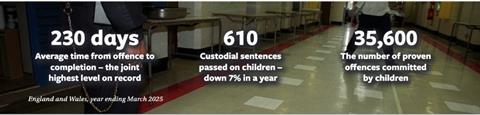
In the foreword, justice secretary David Lammy MP cites facts not commonly acknowledged in media coverage of crime and CYP. Since 2006/07, the number of proven offences by children has fallen by 88%. The number of first-time entrants to the youth justice system has fallen by 93%. And as for the number of children in custody, the figure has tumbled by over 85%.
So why not simply carry on with the policies that have delivered such results? And why do professionals on the frontline of youth justice, including defence lawyers, talk of a crisis?
Hardest to reach
Lammy has an explanation. ‘It is a truism,’ he writes, ‘that as we successfully divert more and more children from crime and the formal youth justice system, those that remain are often the “hardest to reach” – whose needs have been consistently unmet – and the ones who are committing more serious crimes.’
MoJ and Department for Education figures show that 80% of children cautioned have special educational needs, with 32% designated a ‘child in need’. Youth justice, Lammy adds, faces a ‘crisis of complexity’.
In tone, the policy paper is a liberal cri de coeur. It sets out a plan for stable funding for youth justice services through a multi-year settlement. Stability is also promised for the Turnaround programme, which supports children who are on the ‘cusp’ of the youth justice system. And it speaks in damning terms of young offender institutions such as Feltham (see box, p16). Community-based remand arrangements will be boosted, and ways to improve education and activities for those serving custodial sentences are being examined.
That mindset is welcome. ‘The need for early intervention and diversion schemes is fundamental to the youth justice system,’ London firm BCL Solicitors partner David Hardstaff tells the Gazette.

Likewise, reforms of the use and nature of young offender institutions. Jodie Wickers, executive director of children’s rights charity Article 39, says: ‘The UK is a signatory to the UN Convention on the Rights of the Child, which is clear that detention should be a measure of last resort and that children deprived of their liberty must be treated with humanity and protected from harm.’
The UN Committee on the Rights of the Child, she notes, ‘has made clear that the UK’s youth justice system is not compliant with these obligations, raising serious concerns about its “draconian and punitive” nature and calling for urgent reform. A wide range of children’s rights are routinely undermined in custody, including rights to safety, health, education and family life.’
A Modern Youth Justice System promises that the government will soon ‘set out a clear, bold and practical vision for a modern youth justice system’. In doing so, it will have to go much further in scope than it has so far, because this paper makes only passing reference of the role of the police, and mentions the courts just once.
Both are particularly important in ensuring diversion and fair treatment of the ‘hardest to reach’ cohort prioritised by Lammy.
'The need for early intervention and diversion schemes is fundamental to the youth justice system'
David Hardstaff, BCL Solicitors
‘As police forces find themselves overwhelmed with work and woefully under-resourced for the task,’ Hardstaff says, ‘we are seeing repeated failures to appropriately signpost young people at an early stage.’
In his experience, it is often the case that ‘junior police officers who are new to the job know little about the youth justice options available’. In consequence, ‘they take a formulaic approach to investigations, both because this is what they know and sometimes, sadly, because it is the easier option. There must be better training for junior recruits and closer working between busy response officers and youth offending teams’.
A key tool for officers making crucial early decisions is the National Police Chiefs’ Council (NPCC) Child Gravity Matrix. This is a guide for the Youth Justice Service (YJS) and the police – ‘a triage tool to support decision-making for officers, to assist in deciding the most appropriate outcome or disposal for those children and young people, under the age of 18 years who offend’. It describes the options available – both statutory (caution, conditional caution or prosecution) and non-statutory (community resolution, deferred prosecution, deferred caution, voluntary diversionary activity) – and sets out both aggravating and mitigating factors.

Kingsley Napley associate Áine Kervick describes the matrix as a ‘useful guide’. Revised in 2025, it is up to date. But there needs to be a close focus on its use by police and youth justice panels (which have a role in shaping and delivering restorative justice in the context of a referral order) if it is to support Lammy’s ambitions.
The matrix ‘allows the police and youth justice panel discretion to go outside the guidelines where the circumstances justify this’, Kervick notes. And while ‘this elasticity is essential for a child-first approach’, she argues that ‘we need to see greater use of this discretion and increased bravery among police officers and YJS panels to choose a diversion scheme or therapeutic approach over a “safe” caution’.
At present, ‘police discretion is exercised inconsistently’, Hardstaff says. ‘Diversion schemes are often not on the radar at the point of arrest. Courts still sometimes receive children who should never have been charged. Joined-up working sounds straightforward. In practice, it requires resource, training and cultural change across agencies that don’t always share the same priorities.’
Yet, there are examples of the system working well. Kervick relates ‘a number of cases where the CPS has referred a case back to [YJS] after the police did not’. This ‘is positive and demonstrates that there are some safeguards within the system to allow for flexibility to be applied at later stages in the process. Another positive is that YJS, certainly in London, are very efficient once a child is referred to them and responsive to our calls and representations.’
Hardstaff observes: ‘The therapeutic approach to youth justice is one area where principle and practice have genuinely begun to converge – but only in patches.’ Where youth offending teams are properly resourced and embedded in the process early, before charge, he argues that ‘the outcomes are measurably better’.
Custody environments
In April, a 16-year-old boy died after being found unresponsive at Feltham A Young Offender Institution (YOI). Feltham A holds teenagers aged between 15 and 18 who are on remand or have been convicted. Investigations are ongoing, but the incident has shed light on the conditions in YOIs.
Jodie Wickers, executive director of children’s rights charity Article 39, says: ‘This tragic death reflects longstanding and well-evidenced failures in how children are treated in custody.’
YOIs are part of an adult penal system and are not designed to meet children’s needs or uphold their rights, she argues: ‘Institutions such as Feltham have, over many years, been characterised by high levels of violence, instability and harm. These are not environments that can keep children safe.
‘The government owes the highest duty of care to children deprived of their liberty. When a child dies in custody, it must prompt not only scrutiny of the immediate circumstances, but a clear acknowledgement that the system itself is not compatible with the UK’s legal and human rights obligations.’
Wickers points out that it is more than a decade since commitments were made to close YOIs and secure training centres, yet ‘we continue to rely on these institutions that we know cause harm’.
She calls for ‘a clear, time-limited plan for the closure of Young Offender Institutions and the last Secure Training Centre, alongside stricter legal limits on the use of custody and investment in specialist Secure Children’s Homes and community-based alternatives’.
‘You can’t divert everyone,’ a judge who sits on an urban circuit tells the Gazette. Public safety may mean custody is the only option. But judges say they are acutely aware of the shortcomings of YOIs and the further damage time there can do. ‘You know they will be treated badly,’ one relates. ‘You know they will spend a lot of time in lockdown. You know there’s no real education or help.’
In February, justice secretary David Lammy announced his intention to increase the use of ‘community remand’ facilities and to reform YOIs.
Sex crimes
The dramatic decline in proven offences committed by children which Lammy cites will surprise many members of the public. That is in part because of the prominently documented rise of sex and sexual abuse crimes involving children.
The system struggles grievously in cases of alleged sexual crimes. Society finds it difficult to process an idea of children above the age of criminal culpability as sexual beings coming of age, who are vulnerable to exploitation, and also capable of exploitation, but who might also make relationship errors that they respond to with poor behaviour and emotional immaturity. Add to that the involvement of unethical adults, misguided peer pressure, alcohol, drugs and the pervasive presence of technology, and an underfunded legal system struggles.
‘The pattern over recent years is a marked increase in the number of children investigated for sexual offences and a growing trend of schools referring concerns directly to the police,’ says Marcus Johnstone, managing director of PCD Solicitors in Warrington. ‘A major factor is social media, porn and the internet more broadly, which can both foster unhealthy and illegal offline behaviours and draw naive and vulnerable young people into serious online offending.’
While other government departments have a role to play here, the MoJ is at the centre of this set of public policy challenges.
‘I have seen little evidence of much common sense being applied by the police and CPS in cases where a more informal approach would be more appropriate than official legal proceedings,’ Johnstone says.
‘The formal elements of the criminal justice system have largely got their heads around the fact that children share explicit images,’ Kingsley Napley partner Sandra Paul tells the Gazette. ‘It is now an unfortunate but routine factor in dating and experimentation. The CPS guidelines, if followed, should result in educational outcomes that help children make better, more informed decisions with desistance in mind. There is now, thankfully, very clear guidance from the NPCC and the CPS which can be used to challenge errant approaches at an early stage.’
However, there are obstacles to such well-developed directions. ‘The problem is that most parents don’t get it,’ Paul says. ‘Parental pressure and shame either directly or inadvertently blur the issues regarding consent; events are often reframed into something that looks or sounds like pressure or exploitation, which the guidelines indicate may warrant a charge. A more critical assessment of the contemporaneous circumstances is required to prevent erroneous charging decisions.’
The legal profession also has a role here, Paul suggests: ‘Lawyers advising children in this space need to be braver in accepting [wrong conduct occurred].’ Putting the prosecution ‘to proof’ in these cases ‘is sometimes not in the child’s interests where a diversion is available’, she suggests. ‘Knowing the guidelines, charging standards and what is available locally allows lawyers to give robust advice, to resolve matters as early as possible and without charge.’
Trials and tribulations
The very hardest-to-reach children and young people, who have been failed or missed by attempts at diversion and who are accused of the most serious offences, may face trial at the Crown court.
It is easy to engage in handwringing at what feels like a societal failure, and to opine that, in future, early interventions – and wider plans to tackle economic and educational disadvantage – will ensure fewer young people in the dock.
But their consistent and fair treatment matters. The ‘clear, bold and practical vision for a modern youth justice system’ promised by Lammy will have to look at the presence and experience of children and young people at trial.
Criminal law barrister and Bar Council chair Kirsty Brimelow KC says: ‘Special measures are considered in courts, but often they lapse and the court returns to run at its own speed.’
That means ‘long days for children and young people’. Regular breaks are rarely sustained during a trial as other pressures accumulate, she says. ‘There have been many improvements in trying to make Crown courts adapt to children but, generally, if the adaptation is considered impractical, the trial goes ahead as if for an adult, rather than alternative arrangements being sought. There usually are too many competing pressures, which mean that the CYP is expected to adapt rather than the other way around. There is an inconsistency in adjustments applied in the Crown courts for CYP.’
Where a defendant is being held on remand, the impact of such ‘long days’ is worse, she notes: ‘It is also very hard for CYP in custody to concentrate in trials for a full day when either end of the day involves transportation to a place of detention.’
'Children shouldn’t be punished because of systemic delays created by adult systems that are poorly funded and not fit for purpose'
Áine Kervick, Kingsley Napley
Delays are worst in the Crown courts, where the huge backlog is an acknowledged fact. The situation is better in the magistrates’ and youth courts. But whatever the setting, delays have an impact.
‘As with all individuals navigating the criminal justice system,’ says Johnstone, ‘child defendants and their families are massively affected by trial delays, and delays in forensics and investigations, that are impacting the system more widely.’
While they wait, he points out, a child may be suspended or excluded from school, ‘depriving them of the routines and support systems that can be so important for individuals in such difficult circumstances’.
Kervick identifies a further problem: ‘A major gap in these schemes arises in cases where delays – by the police, CPS, courts – mean that children who committed crimes and turn 18 before the matter is resolved will be outside the scope of these early intervention schemes.’
In planning to ‘modernise’ the criminal courts, the MoJ has set itself the task of reducing delays. But on the issue identified by Kervick, an additional public policy change is also needed. Not least, even without delays, many child offenders are on the cusp of adulthood.
‘An obvious solution,’ Kervick urges, ‘is to create a category within these schemes for dealing with young adults who fall within this [cohort] and to remove the criminal record implications of an adult caution where the offending behaviour took place under 18… Children shouldn’t be punished because of systemic delays created by adult systems that are poorly funded and not fit for purpose.’
In a fix
Judges to whom the Gazette spoke
said they seek to improve the experience and fair treatment of CYP on trial, notably in the adult environment of the Crown court. That extends from chequered attempts to prevent postponement of listing dates, to correspondence with prisons and youth offender institutions when defendants appear too tired to engage with the court.
That is creditable, but individual judges using their ‘good offices’ to ameliorate the failings of an underfunded system is not a policy solution.
As justice secretary, Lammy is not short on ambition. One can detect a flash of anger in his declaration that the ‘hardest to reach’ children and young people are ‘those whose needs have been consistently unmet’.
But as A Modern Youth Justice System notes: ‘There is no escaping from the fact that the fiscal environment remains challenging for public services.’ In that context, when Lammy sets out his ‘bold and practical vision’, he will need to focus on improving consistency in the decisions made, and the support that is provided, when children and young people are accused of a crime.









No comments yet