

















'Like Nazi Germany'
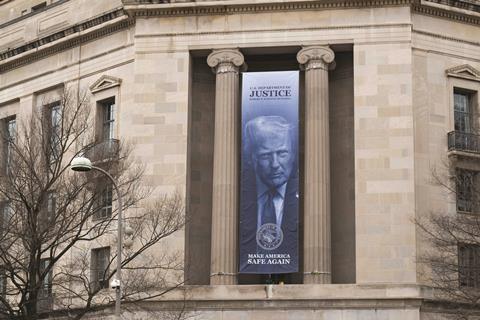
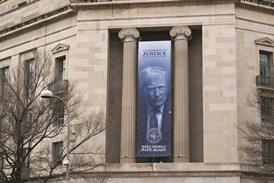
In another sign that the US justice system’s independence is in a stress position, the most eye-catching adornment of the Department of Justice’s main building this Spring is not the Stars and Stripes fluttering in a breeze bearing petals from Washington DC’s famous cherry blossoms. It is a three-storey-high banner bearing president Donald Trump’s face above the legend: ‘Make America Safe Again’.
On 14 May, the DoJ’s lawyers will be in the Court of Appeals for the District of Columbia for oral arguments in the grouped cases of four law firms which were the subject of executive orders last year (Jenner v Department of Justice).
Following the executive orders, each of the quartet (Perkins Coie, Jenner & Block, WilmerHale and Susman Godfrey) won federal court injunctions against the orders, first as temporary restraining orders, then as full judgments permanently blocking them.
Trump’s orders posed an existential threat to the targeted firms. They would have meant the withdrawal of security clearances for all the firm’s personnel, effecting a bar on entering federal government buildings, including the premises of regulators and courts. The orders required private businesses with government contracts to report on and terminate instructions to the law firms or lose their government contracts. And they labelled the target firms’ DEI policies illegal, barring federal agencies and businesses with government contracts from hiring their staff.
Each order represented what the firms affected view as unprecedented interference in a private business by federal government. But law firms in particular can lean on numerous constitutional protections against such retaliatory actions.
The restraining orders and judgments that nullified Trump’s orders were excoriating. DoJ’s filing to the appeal court signals a tactical shift.
The department’s approach is being read as an admission that a comprehensive victory is not on the cards for Trump. Instead, a partial win is sought. The submission asks the court to examine each element of the executive orders separately.
The DoJ’s brief argues that the president has the constitutional powers to deal with threats to national security and racial discrimination in the legal profession. ‘The president wants some of the provisions to take effect even if others are enjoined,’ its brief says.
'A universal consensus has developed that recognizes the indispensable role of lawyers safeguarding democracy and the rule of law'
Lawyers for Lawyers
Between 30 March and 2 April, 14 amicus briefs were filed in support of the four firms. Such briefs are provided to the court by non-parties to assist with an understanding of a case’s context.
The American Bar Association (ABA) argues against ‘starkly unconstitutional sanctions on firms… that represent clients and positions adverse to the Administration’. Citing the constitution’s First Amendment, it says that ‘the [executive orders] reflect an attempt to suppress speech and cannot be sustained’.
One brief is signed by 595 law professors. Another, by ‘1,224 Law Students and 50 Law Student Organizations’, says the executive orders ‘represent government reprisal’ and that: ‘Left alone, the orders will erode the legal profession’s independence and the rule of law that the legal profession serves.’
The Law Society and Bar Council are among 21 European bar associations named in an amicus brief, which states: ‘In sum, courts across jurisdictions have converged on a common understanding: lawyers must be free from improper governmental interference to fulfil their role as guardians of justice. Compromising that independence not only threatens individual rights but also damages public confidence, undermines the legitimacy of democratic institutions, and jeopardizes the rule of law itself.’
‘History offers stark lessons,’ it notes elsewhere. ‘In Nazi Germany, dismantling the independent bar was an early step in subordinating the legal system to the regime. More recently, a troubling pattern of interference with the profession has emerged in other regions. For instance, in Russia, Turkey, China, and Hong Kong, as well as in European countries such as Poland.’
Independent organisation Lawyers for Lawyers, meanwhile, which seeks to defend ‘lawyers at risk’, stated: ‘Set out in multiple instruments, including the United Nations’ landmark Basic Principles on the Role of Lawyers, a universal consensus has developed that recognizes the indispensable role of lawyers safeguarding democracy and the rule of law.’
For law firms which faced the threat of an executive order, but avoided that outcome by coming to terms with the White House (including by promising $40m-$125m in pro bono work), there has been no neat Faustian pact. Such deals have caused tension within international partnerships, generating practical as well as moral objections. Firms are committing to axe diversity commitments and initiatives in the US, but must comply in the UK and EU with requirements including mandatory gender pay gap reporting, and professional rules on upholding diversity and equality.
More immediately, are the firms that arguably capitulated to Trump on a collision course with the ABA? Writing for Bloomberg, Seattle University legal academic Seth Katsuyo Endo argues the ABA’s rule of professional conduct ‘prohibits law firms from promising pro bono work to avoid White House sanctions’.
Membership of the ABA is voluntary and it is not a regulator; but its model code of conduct is as an industry standard in most US states.
This article is now closed for comment.











17 Readers' comments