
























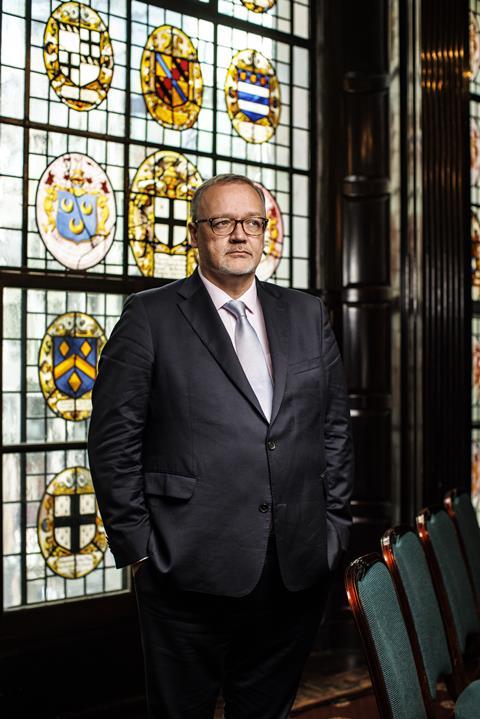
Brett Dixon may be a digital aficionado but he’s unconvinced that AI alone can improve access to justice. Humans will remain front and centre, the new Law Society president tells Paul Rogerson
BIOG
BORN
Burnley, Lancashire, 1974
EDUCATION
University of Leicester, LLB (Hons) (1993-1996)
College of Law Chester, LPC (1996 to 1997)
Admitted as a solicitor (1999)
ROLES
Solicitor –
Rowlands (1997-1999)
Towns Needham (2000-2003)
Lupton Fawcett (2003-2006)
Smith Jones (2006-2019)
Scott-Moncrieff & Associates (Ended 2025)
President, Association of Personal Injury Lawyers (2017-2019)
Past chair and current member, Law Society Civil Justice Committee
Civil Procedure Rule Committee (2016-2022)
Online Procedure Rule Committee (2023-present)
Beta testing for Google, Microsoft and Netgear, including AI tools
KNOWN FOR
President, Law Society (2026-2027)
Brett Dixon has described himself as ‘an unashamed geek’. He codes to relax, beta-tests software and builds computers at home.
As his career has developed, Dixon has gravitated towards the point where law and technology meet. He once spent a convivial hour or two in the pub with incoming master of the rolls Sir Colin Birss, discussing what artificial intelligence could mean for the justice system.
Technology is no panacea for Dixon, however. Ask the incoming president of the Law Society what he wants to achieve during his tenure and the answer is not AI, court reform or digital transformation. He consistently comes back to people and their needs.
‘Really, if you stand back from it all, there are two aspects to it,’ he tells me. ‘The first one is access to justice. The second one is access to the profession.’
Those themes are familiar enough for any president. What sets Dixon apart from many of his predecessors is the public-facing route he has taken to the summit.
This ‘lad from Burnley’ is already a well-known face in policymaking circles. He built his career in claimant personal injury work, serving as president of the Association of Personal Injury Lawyers. He has worked as a consultant in personal injury law and represented vulnerable clients whose lives have been transformed by serious injury. He has long been closely involved in questions of court reform and public policy, which ought to be extremely useful to the Society in its lobbying efforts on multiple issues. He knows the territory.

But back to Burnley. Dixon was the first person in his family to attend university and the first to become a solicitor. That experience remains central to how he thinks about professional opportunity.
‘It is about ensuring that there are people able to join the profession, to feel part of the family of the profession, and to give everything that they can and be the best that they can in it,’ he says.
While Dixon does acknowledge that the profession has become more diverse, he argues that headline entry figures only tell part of the story. ‘When you look beyond the numbers coming in,’ he says, ‘and you look at those that reach the heights of the profession, or if you look at the judiciary, significant questions remain.’
Disability inclusion is a personal interest. Dixon speaks about his daughter, who was born missing an arm below the elbow and is now studying common law and politics at university. The experience has helped shape his thinking about the profession and the workplace. ‘What we really need to do is listen to people regarding how they want things to work, and what reasonable adjustments can be made when they move into a job to enable them to do their best,’ he adds.
The wider question of representation leads him neatly on to the bench. Dixon notes that solicitors remain hugely underrepresented and that judicial diversity continues to lag wider social change. Yet he rejects the common perception that the problem stems from a shortage of talented solicitor candidates.
Instead, he points to seemingly intractable practical barriers. Judicial diversity initiatives, he points out, are examining questions relating to the working arrangements that allow solicitors to undertake part-time judicial service while maintaining careers in legal practice. Partnership structures can make such commitments difficult, of course. Barristers, being largely self-employed, often have greater latitude to indulge their judicial ambitions.
Meaningful change takes time, Dixon concedes, but incremental improvements still matter.
'We need a coherent strategy for the justice system as a whole'
Dixon’s spell leading APIL coincided with repeated debates over personal injury reform, costs, damages and access to representation. The experience appears to have strengthened his view that solicitors should help shape policy rather than simply respond to it. He is certainly no stranger to the brinkmanship involved in political engagement.
That belief followed him into the Law Society after his election to Council as the representative for claimant personal injury solicitors. Since then, many of the issues that have interested him most have been systemic: how courts function, how regulation works and how legal services will evolve in a digital age.

Streamlining dispute resolution
The Online Procedure Rule Committee was set up under the Judicial Review and Courts Act 2022 to make rules governing practice and procedure for specific types of online court and tribunal proceedings across the Civil, Family and Tribunal jurisdictions. It aims to ‘improve access to justice for all by harnessing the power of modern digital technology in the pre-action space’.
Chaired by the master of the rolls, the committee is made up of six members – including Brett Dixon as solicitor representative. ‘Much of the work done by the Law Society for its 21st century justice project has underpinned a lot of the thinking about how one might approach the pre-court space and how one might then go on to build the digital systems that sit around it,’ Dixon says of the OPRC’s work. ‘So [the committee] is now beginning to move out of the “planning” phase and into the “doing” phase.’ One of the core recommendations of the 21st century justice project concerned online dispute resolution: reforming and strengthening out-of-court dispute resolution processes and ombudsman services to make resolving disputes faster and more affordable.
Most recently, at the end of September, the OPRC issued a practice direction supplementing the Online Procedure Rules by setting out detailed requirements for the digital service for possession proceedings.
Dixon is ideally positioned to both represent and advise on digital justice, as he is solicitor member of the Online Procedure Rule Committee (see box). His involvement in court reform has also brought him into longstanding collaboration with senior judges, including Sir Colin Birss.
Dixon traces their association back to their work on the Civil Procedure Rule Committee. During the pandemic, he says, they helped develop the idea of allowing claims to be issued online when access to offices was restricted. He describes the incoming MR as a practical reformer whose focus is making systems work. In that regard, Birss would seem to be the ideal successor to current master of the rolls Sir Geoffrey Vos, who can be fairly described as a technology evangelist.
‘[Sir Colin] will have an interest in making sure the system works,’ Dixon says, ‘which means working with the professions to identify where the problems are and then building out from that.’
'These are real people. Real business problems underpin all of this. Solicitors have always been at the heart of that'
Far from believing that technology can somehow rescue an ailing justice system, he repeatedly argues that digital reform has to begin with a clear understanding of what it is that reform is actually trying to solve.

‘We need a coherent strategy for the justice system as a whole,’ he adds. Court backlogs, legal aid deserts, an ageing duty solicitor population and deteriorating infrastructure all remain to be properly addressed. There is little point, he suggests, investing heavily in digital capabilities if the underlying system lacks the people and resources needed to function effectively. Without ‘the correct number of lawyers, the correct number of judges, and court buildings that work and aren’t falling apart’, any reform programme is doomed to fall short.
‘You have witnesses and you have the accused, who can sometimes wait for over a year or more to get resolution of their issue. If you step into the civil space, it’s the “butcher on the high street in Burnley” who’s had a problem with their supplier. Where do they go? They’ll go to the court but their issue just doesn’t get resolved quickly enough. These are real people. Real business problems underpin all of this. Solicitors have always been at the heart of that.’
But is Andy Burnham’s government listening? ‘The important thing is to be able to have those conversations and be at a point where you can make what hopefully is a consistent and considered message for investment across the piece,’ Dixon answers carefully. ‘And if you do that, it improves our “shop window” for international work, which the government is very interested in maintaining because of its input to the economy.’
Get all this right, and digital systems can improve public access to justice and create processes that feel more intuitive to people accustomed to managing much of their lives online. The challenge is ensuring that technology supports legal principles rather than replacing them.
Dixon’s views on AI reflect the same balance. Long before ChatGPT entered public consciousness, Dixon’s conversations with Sir Colin Birss over a beer spawned one of the former’s favourite descriptions of the technology.
AI, the pair decided, is ‘a talented research assistant you don’t quite trust’. AI can process information quickly, identify patterns and help professionals work more efficiently. But it remains dependent upon the quality of the instructions it receives and the judgement of the person reviewing the outcome.
‘AI is good, but it’s only as good as the instructions you give it,’ he stresses. ‘The core problem is, how do we deliver access to justice? How do we live and breathe the rule of law? Digital enables people to work with the system in a recognisable way. It can deliver big changes in how you do bulk tasks. So, if you read the Leveson report, for example, he will talk about using it to deal with some of the court listing issues. I was at the Rolls Building the other day with the Vietnamese bar and the listing officers showed us how they list some of the very big, commercial heavyweight trials. It is still a very, very manual process. What [AI] can’t do is deliver human solutions to human problems.’
'Many small firms do not have the capacity to evaluate rapidly changing technology markets while continuing to serve clients'
Dixon has argued that innovation cannot come at the expense of confidentiality, accuracy and fairness, and that a lawyer’s judgement remains a non-negotiable element of delivering justice. That philosophy is likely to inform one of the core projects he wants to pursue during his presidential year.
Dixon believes smaller firms risk being left behind in the race to adopt new technologies. Large firms often have the resources to experiment and invest; smaller businesses and sole practitioners frequently do not.
‘There is a gap in time and ability,’ he says. Many small firms simply do not have the capacity to evaluate rapidly changing technology markets while continuing to serve clients.
To help address that problem, he is keen for the Law Society to provide practical guidance that will help solicitors assess AI products, understand their own business needs and ask informed questions of technology providers. The purpose is not to endorse particular tools, but to democratise knowledge that is already becoming commonplace in larger organisations.
His concerns become sharper when discussion turns to agentic AI systems capable of carrying out increasingly autonomous tasks. If lawyers decide to delegate work to such systems, Dixon once again stresses, responsibility for the outcome remains with the lawyer. He also questions whether courts and the wider justice system have yet fully grappled with the consequences of widespread deployment.
Indeed, we know that AI is creating new pressures for an already overstretched justice system. Dixon points to growing numbers of litigants in person who use AI tools to generate lengthy submissions. The problem is not accuracy alone, but also volume. Judges still need to read the material placed before them. That requires time – potentially adding to court delays.
The example illustrates his wider point. Justice systems are interconnected. Increasing judicial resources without improving access to legal advice may simply move the problem elsewhere.
On funding gaps more generally, I conclude by mentioning the government’s highly controversial proposals to seize the interest on client accounts. There has been no formal confirmation yet. But the fact that the Ministry of Justice has maladroitly advertised for senior civil servants to implement the plan bodes ill for law firm bottom lines.
‘The real problem here is that [the government] is simply taking away money without thinking about how it is doing that,’ complains Dixon. ‘This would destroy a number of small businesses which will no longer be able to deliver the legal aid provision that they do now. Many of them rely on the [client interest] cross-subsidies to enable them to do that kind of work, which is already desperately underfunded.’
He adds: ‘We all know that interest fluctuates. So how do you know, for example, how much it’s going to deliver each year? And there’s been absolutely no guarantee that it will be ringfenced [for justice] either. I can say as a PI practitioner, if you have someone with a catastrophic injury and they don’t have capacity, some of that money sits in a client account and it’s their interest. It feeds into their ability to do things that they need to do, like buy a home and rebuild their lives.
‘This is an idea that’s just not been thought through properly. We hope the government will take a step back and rethink.’
Bring on the budget.
Photograph by Darren Filkins









No comments yet