






















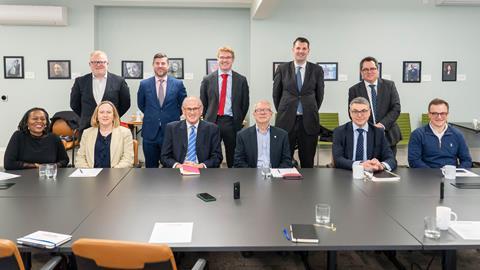

Stable prices and ample capacity remain benign characteristics of the PII market, but some experts fear that cost does not reflect risk. Eduardo Reyes reports from the latest Gazette Roundtable
AT THE TABLE
Back row (l-r) Paul Bennett Bennett Briegal; Chris Ficken Juno Indemnity; Philip McCormack DWF; Marc Rowson Lockton; Eduardo Reyes Law Society Gazette
Seated, front row (l-r) Donna Goodsell Goodsells Family Law; Joanna Pratt Thomson Snell & Passmore; Ed Pickard Miller Insurance; Owen Thomas Law Society PII committee; Bill Montague Dexter Montague; James Graham Travelers
It is possible to paint a rosy picture of this year’s professional indemnity insurance (PII) market. The price of cover has increased modestly. There is widespread interest in underwriting solicitors’ cover, meaning there is ample capacity in the market and competition on price.
The excess layer of insurance is subject to no turbulence. Conveyancing conducted under pressure during the pandemic has not produced the avalanche of claims some expected. And despite concerns that the Building Safety Act 2022 would lead to lawyers being held accountable for post-Grenfell cladding issues, very little litigation has resulted.
Marc Rowson of broker Lockton is ‘pleased to say market conditions still seem to be favourable’. He attributes this ‘first and foremost’ to ‘a continuation of capacity’, explaining that ‘supply has got larger and demand has stayed pretty much the same. The market’s in a good spot and there’s more choice than there has been’.
‘We’re definitely confident, as brokers, that we’ll be able to support our firms very positively and achieve improvements in terms,’ says Miller Insurance’s Ed Pickard. But he cautions: ‘My concern is that some of the insurers “entering the market” won’t always look in as detailed a way as others at every risk and will just fight for business on price.’ If that is the case, ‘we could start seeing the problems that we saw before, where the price was not adequate for the claims activity’.
'Having a good working relationship with your insurers is really important'
Joanna Pratt, Thomson Snell & Passmore
The discussion’s third broker, Juno Indemnity’s Chris Ficken, points to the risk that established insurers decide that they are ‘just not going to follow these prices down’. To ensure the stability of the market, when securing cover, ‘we really need to concentrate [on] service – its longevity, sustainability,’ he says. ‘Price is important, but it’s not the only thing.’
‘I’d think carefully before thinking purely on price,’ concurs James Graham of PII insurer Travelers. ‘You want an insurer that’s got a really good security rating, one who’s been in the market for a long time. And also there’s various other factors that you can think about: whether they’ve got a risk management offering, what their claims service looks like, what the limit looks like, whether the cover is co-insurance or how your total limit is structured.’ (Co-insurance is where an insurer has split the risk of cover with other parties.)

Owen Thomas, a member of the Law Society’s PII committee, observes: ‘The headline of a “softer market” sounds great, but is that the reality? Can you actually get a claim in?’
Thomas highlights another risk: ‘Very often, people try to reduce premiums by having higher excesses. And, of course, if the firm isn’t particularly liquid, [and if] they have a series of claims, they can find themselves bankrupt pretty quickly.’
Given the interest rate rises of recent years, Graham notes that some firms have become dependent on the interest paid on client cash – profits from which mask otherwise poor financial management. ‘For us, there’s definitely a real focus on firms’ financials.’
'Law firms, as long as the premiums remain manageable, are likely to be pretty sticky when it comes to their relations with their brokers and insurers'
Bill Montague, Dexter Montague
How do the law firms present view the PII market this year? Joanna Pratt, senior partner of full-service Kent firm Thomson Snell & Passmore, says: ‘Indemnity cover is one of our most significant outgoings and therefore price is something that we look at. But certainly, for our firm, it’s not the be-all and end-all. Having a good working relationship with your insurers is really important because, while you don’t want to be in a position where you’re making a claim, most law firms at some point will be. And having the kind of working relationship where you deal with that more constructively is worth something.’
‘What drives a firm to be particularly concerned about premiums might be if they are starting to escalate,’ notes Bill Montague, senior partner at Berkshire firm Dexter Montague. ‘But in a period like the past few years, where the premiums have been steady and/or dropped, then we’ve got the liberty and the luxury of really adding value to that relationship. Continuity has been a big factor for us in recent years and I would say that law firms, as long as the premiums remain manageable, are likely to be pretty sticky when it comes to their relations with their brokers and insurers.’

Yet for some, there is merit in shopping around. ‘I’ve always had a good relationship with my insurer and broker,’ says sole practitioner Donna Goodsell of south London firm Goodsells Family Law. ‘But as a result of attending [the Gazette’s PII roundtable] last year, I started shopping around and found a quote that saved me £1,500. As a sole practitioner, that is a significant amount of money.’
Lockton’s Rowson interjects to note: ‘Some of the “new entrants” will be underwriters who have got longevity in this space.’ A good broker should know, he says, about ‘nuances within the new entrants’.
'The headline of a ‘softer market’ sounds great, but is that the reality? Can you actually get a claim in?'
Owen Thomas, Law Society

Claims up
Against a benign market must be set the current experience of claims related by some at the table. Miller’s Pickard says he is ‘seeing a lot of large claims… either being notified, reserved or actually paying [out]. In this situation, there’s two graphs – one of the premium going down and one of claims going up. And I think the claims are going up quicker than I’ve seen in the past.’
‘We’re definitely experiencing increased notifications,’ Travelers’ Graham notes. He cites in particular private client claims related to advice on wills, trusts and probate: ‘There’s more willingness to litigate or at least argue over what a draft of the will was meant to do and who should get what.’
What sits behind that trend? An increasing population that is getting older, a rise in the value of estates fuelled by the house price boom and more complex family structures all play a part. As a result, Graham notes: ‘The cost of defending claims is increasing… it doesn’t quite match what you typically see with market conditions, where softening would mean an improvement in claims.’
Internal risks
Juno Indemnity’s Ficken identifies a key business risk for law firms which, if left unaddressed, will make them less attractive for insurance purposes. ‘One thing law firms should really concentrate on is succession,’ he says. ‘We have a serious issue with an ageing profession, where people don’t look at the future. When they do look at the future is when they’re trying to get out of the door – not 10 years before, when they should be trying to get people to come through.’
'I talk to law firms all the time who don’t want to report a negative circumstance'
Paul Bennett, Bennett Briegal
Paul Bennett, partner at Bennett Briegal, which specialises in advising professional practices, highlights internal risks. These are enhanced by the growth of technology, he says, and the possibility of changes to the treatment of interest on the client account. The government is consulting on plans to seize much of this boon. The latter could heighten financial pressures on firms, increasing the likelihood of fraud or errors.
Firms that respond with a lack of candour to their insurer are another bugbear, he notes: ‘I talk to law firms all the time who don’t want to report a negative circumstance.’ Such a sense of denial harms the relationship with an insurer as one of ‘partnership’ that benefits both, he suggests.

Excess layer
Professional indemnity cover in excess of the minimum required by the Solicitors Regulatory Authority is held by many law firms. Commonly, this reflects the fact that the firm has a theoretical level of risk not covered by the minimum, which it is not willing to carry. This includes advising on transactions, particularly property transactions, that are high-value.
Another category is directors’ and officers’ insurance, while solicitors are also among those who purchase managing agent (MGA) insurance to advise on significant property developments.
‘It’s all got a very similar feel to what the primary market’s doing,’ Juno Indemnity’s Ficken says. ‘Excess layer is definitely becoming cheaper and more accessible.’ On MGA policies, he adds: ‘The world is changing – a lot of firms want larger towers!’
Does a risk appetite that is too low lead to some firms purchasing unnecessary levels of cover? ‘I’d be really keen to know whether or not brokers, and James Graham as an underwriter, see firms buying too much… excess layer,’ Bennett asks.
He adds: ‘Historically, firms have been anxious about making sure they’ve got sufficient cover. One thing that we’re seeing a lot of is firms having £20m, £25m as total cover, but actually they’re not doing any work that could generate anything over £8m or £10m.’ For example, a niche firm which has spun out of a much larger general practice may simply have matched the [previous] coverage. However their risks now being distinct, they may have overinsured.’
Brokers recognise the scenario, but Lockton’s Rowson notes that one reason is the way aggregation clauses operate. These clauses in insurance agreements determine what can be deducted from any claim and the available limit of liability.

Aggregation in PII is the process by which an insurer treats two or more related claims as a single claim. For example, a solicitor makes the same error across several client matters – giving the same incorrect advice on a standard clause used in multiple transactions. Each affected client has a separate claim, but the insurer may argue that those claims all arise from ‘similar acts or omissions in a series of related matters or transactions’. This means only one indemnity limit applies to the entire group of claims rather than a separate limit per claim. This may adversely affect the firm if the total exposure across the aggregated claims exceeds the single limit. Case law has not given a definitive steer, despite a key 2023 case, World Challenge Expeditions Limited v Zurich Insurance, which favoured the insured.
Further, Rowson says, firms need to pay close attention to the wording of both their compulsory layer and excess layer. It may be that ‘the wordings don’t actually align. So you’ve got gaps then from one layer to the next’.
Thomson Snell & Passmore’s Pratt notes: ‘We take quite a considered approach and want to make sure that we aren’t taking on matters that are in excess of the highest part of [our] insurance.’
Miller Insurance’s Pickard points to a situation in which firms ‘are considering taking on work which requires them to purchase increased limits’. He adds: ‘What they don’t factor in is the requirement to continue to purchase that level of insurance cover for another six years’, due to the risk of a claim arising in that period.
The Society’s Thomas observes: ‘It comes down to you as the buyer of insurance really knowing what the risk of your business is.’
It is a mistake, Thomas suggests, to take out insurance in lieu of managing risk properly. He references a scenario where ‘the biggest fee-earner in the firm is the biggest risk for the firm’. That person is ‘untouchable because of their importance to the business’ and therefore is not subject to any supervision or review.
‘Eventually, when he becomes exposed, you’ve got multiple claims because it’s been going on over many years with many transactions,’ Thomas says.
‘Partners are so often exempt from supervision. They shouldn’t be,’ Bennett confirms. ‘Supervision’s never been more important. Not just because of Mazur, not just because of technology use, but because, actually, if you want to manage risks well, you’ve got to supervise partners. And that means all partners.’
Looking your best
To secure the best and most suitable cover at a price that reflects their risk profile, law firms need to do more than fill in proposal or renewal forms truthfully. Our panel has some advice.
Ed Pickard, Miller Insurance: ‘As a broker, I would say we understand what the insurance market is looking for better than you might… what we help you to do is be aware of what each insurer is looking for and what they’re prioritising.’ Financial probity is important to insurers, therefore: ‘How can you show that and demonstrate it in a proper way?’ Also important is how a firm handles anti-money laundering regulations and sanctions. ‘We help you to put together a presentation that effectively ticks the box for each insurer. And it’ll be different for different insurers.’
James Graham, Travelers: ‘Often, when we receive a submission, it’s just a claim summary which has a list of names on it.’ The problem with such a minimalist approach is ‘you don’t actually know anything about the claim’. As an insurer, Graham wants to know how the firm ‘learned lessons’ and that it has ‘put in measures to prevent this sort of thing happening again’.
Marc Rowson, Lockton: Firms need to explain the significance of investments they have made in risk management. ‘Firms are quite good at saying, “We’ve done this”. But then they don’t give themselves opportunities to follow through and help an insurer understand why. Good explanations, he says, are ‘quite powerful’.
Chris Ficken, Juno Indemnity: Firms also need to recognise that the sources of risk may not be the same year to year. In that context, says Ficken, ‘keeping fingers on the pulse’ is important: ‘That’s the biggest thing law firms have to do. Keep in contact with other local firms and your brokers.’ That will provide ‘guidance about what’s potentially concerning’.
High-risk areas
'Conveyancing, both commercial and residential, remains the biggie'
Philip McCormack, DWF
‘I am still talking to firms which are having to report… conveyancing transactions predominantly when things have gone wrong,’ says Bennett. ‘It’s always when their processes have fallen down, when the supervision has fallen down, where people are busy. It’s that classic human error.’
Referring to his own view of Solicitors Disciplinary Tribunal decisions, Bennett adds that such errors are often compounded: ‘If you look at the recent decisions… I think the trend in those is people not being candid when things go wrong. And I think all firms know that you have to be candid.’
Philip McCormack is a director at DWF and, like Bennett, an adviser to firms and solicitors on professional negligence claims. He confirms: ‘Conveyancing, both commercial and residential, remains the biggie.’ This is attributable to a high-volume, low-margin workload, with many solicitors working on a fixed-fee basis where that fee is set too low.
Bennett also considers why the forecast spike in conveyancing claims attributable to the working arrangements of the pandemic’s lockdowns did not materialise.

‘I’ve got a pet theory,’ he says. ‘In lockdown and the post-pandemic world, where people were having more time at home, they were able to [take] the difficult jobs, the challenging jobs, and they were able to take time out to focus on them. They were in a calm environment free of distractions.’
Recalling the same period, Montague says: ‘The volume surge was a really difficult thing to manage and I would have expected there to be an increase in claims. The fact there hasn’t been is fantastic.
‘What concerns me more when we look at what’s going on in conveyancing is the general dumbing down of the industry. There’s a lot of people doing conveyancing… They don’t necessarily know very well what they’re doing. The highly trained conveyancers find that quite frustrating.’
Despite the small number of claims related to the Building Safety Act, meanwhile, McCormack relates ‘a lot of uncertainty’. On wills, probate and trusts, he confirms the perception that claims are rising because of inflating asset values.
Artificial intelligence
The growing use of artificial intelligence (AI) tools is a more recent factor affecting the market. Insurers are asking firms to provide information on their use of AI and levels of supervision.
DWF’s McCormack suggests that there needs to be increased regulation of AI use, led by legal regulators. ‘There’s room for a lot to go wrong,’ he remarks.
‘The biggest problem I see with AI is confidentiality,’ says the Law Society’s Thomas. ‘Some of the firms I’ve spoken to say that they have ringfenced AI. But if you are, say, a firm that didn’t really know that much about how things worked and then you put your clients’ information into an AI programme to get an answer out, where does that go? You’ve got no control over that information, unless you’ve got it ringfenced. And even if it’s “ringfenced”, is it really ringfenced?’
Firms need to understand the software to know their risks, Bennett points out: ‘We won’t use ChatGPT because of data security. But that is the same program that powers Microsoft Copilot, where there is a completely different data strategy which complies with UK GDPR and European GDPR. So we will use Copilot.
‘Now, that’s the same technology, but the deployment model is different. Claude is fantastic in many ways, but safe deployment is different to other AI models because the data security considerations differ between the models. We use Claude on a device without client data access as we are not big enough to acquire the enterprise version.’
Such nuances are not always understood, Bennett says. ‘I look at those tools as future disputes waiting to happen. Because if you have an unskilled person using them in a way they’re not clear about, they’re going to cause a problem.’
He adds: ‘The thing that really intrigues me about AI is that people don’t understand how it’s different to previous technologies.’
Bennett recalls a generative AI training session. Six experienced professionals on the same course, given the same data and using the course provider’s computers, received six different answers from the same AI tool.
Goodsell adds: ‘Historically, [to] get a financial settlement, I would draft a consent order and send it to the court and the court would approve it. Now, people are going to ChatGPT, creating their own consent orders and sending them to the courts, and the courts are approving them.’
That may seem unsatisfactory to experienced solicitors, but how would it feed through to an increase in their own risk of facing a claim? Thomas explains: ‘Some academics have suggested, to increase access to justice, that practitioners use the limited retainer model far more.’
He cites the example of a matrimonial order, for which a client may come to a solicitor and say: ‘We’ve got an agreement. Will you just turn this into something?’ The danger here is that the solicitor ‘had no part to play in putting that agreement together’.
Yet, as Thomas stresses: ‘It’s your document that’s going to court.’
This roundtable was kindly sponsored by Juno Indemnity, Lockton, Miller Insurance and Travelers

Photographs by Noah Da Costa













No comments yet