

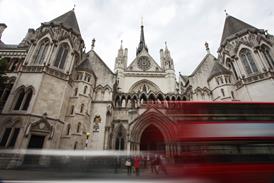



















First purchased by HMCTS in 2022 for £111m and scheduled to go live the following year, the UK’s largest dedicated tribunal centre is set to open at last. The Newgate Street development next door to the Central Criminal Court in London, which houses 30 hearing rooms, will host its first employment tribunal (ET) case in March.
Social security and child support disputes will also be heard in the seven-storey centre. Victory House on Kingsway, where the London Central Employment Tribunal currently sits, will close, as will Fox Court on nearby Gray’s Inn Road.
Courts minister Sarah Sackman this week described Newgate Street (pictured) as ‘part of our plan to modernise the estate, recruit more judges and restore access to justice’ – though of course the centre’s gestation long predates the present government.
The capital seems relatively well placed to cope with the well-documented and mounting backlog of cases of all types. The new London Law Courts complex on Fleet Street for example, which will house 18 courtrooms to hear Crown, magistrates and civil cases, is due to open next year. But what of the rest of England and Wales?
The MoJ has flagged the development of West Gate in Leeds, opened in 2024 and part of a £220m funding package benefiting a number of sites in Yorkshire. West Gate has four Business and Property courtrooms, and eight ET rooms. New courtrooms have also recently opened at Hereford Justice Centre, Sheffield Crown Court and Redditch Crown Court, and there has been ‘extensive refurbishment’ of Birkenhead County Court.
Last month Sackman also announced that four pandemic-era ‘Nightingale’ courts would become permanent facilities, adding another 11 courtrooms.
All very welcome, but ministers are hardly off the hook. Critics point out that courtrooms across the existing estate are sitting empty. Statistics published by legal blogger Daniel Cloake show the percentage of courtrooms not in use in England and Wales this year has varied from 9% (48 courtrooms) on 20 January to 17% (88) on 5 January.
To deploy courts at optimal capacity, judicial availability and sitting days must be addressed too. As Lord Justice Dingemans, Senior President of Tribunals, pointedly noted in his annual report: ‘Increasing the number of judges, and in particular salaried judges, will assist in addressing backlogs’.
A spate of high-profile departures among leadership judges, creating gaps up the chain, will hardly help in this respect. Master of the rolls Sir Geoffrey Vos and Dame Victoria Sharp, president of the King’s Bench Division, are retiring in October, while president of the Supreme Court Lord Reed is going next January. President of the Family Division Sir Andrew McFarlane retires at Easter.
Figures show that as of 1 April 2025, there were 108 High Court judges - the statutory maximum - 120 deputy High Court judges, 746 circuit judges, 1,010 recorders, 165 employment judges and 143 fee-paid employment judges.
The government... must invest in the people who make the courts function, alongside the court estate
Brett Dixon, the Law Society
Fourteen High Court vacancies have been advertised, while in January a recruitment exercise was launched for 64 circuit judges (45 in crime). Requests have also been made for 55 employment judges and 45 deputy High Court judges, with recruitment exercises set to launch next month.
In 2024/25 the Judicial Appointments Commission concluded 34 recruitment campaigns. Of those, the JAC made 944 selections. A further 19 exercises continued into 2026, according to JAC’s most recent annual report, illustrating the difficulties of keeping the bench adequately stocked.
Law Society vice president Brett Dixon commented: ‘New court buildings are welcome and long overdue, but buildings alone will not deliver justice. This essential public service relies on the people who run it. Without enough judges, court staff, lawyers and sitting days to move cases forward, new courtrooms risk standing empty. If the government is serious about cutting court backlogs and restoring public confidence in the justice system, it must invest in the people who make the courts function, alongside the court estate.’
As Dixon says, decent infrastructure is just one element of a complex and expensive tapestry of provision. State-of-the art or at least refurbished accommodation is most welcome, but finding the right people to fill it remains the more intractable task.
A government spokesperson said: ‘The government inherited a justice system in crisis, with a huge court backlog meaning victims are waiting too long for their cases to arrive in court. That is why we are driving once-in-a-generation reforms and funding record levels of Crown court sitting days, alongside continuing to invest in the recruitment of approximately 1,000 judges and tribunal members per year.’