






















Outgoing master of the rolls placed technology at the centre of an efficient civil justice system, setting out a revolutionary vision. So how many of his predictions are approaching reality?
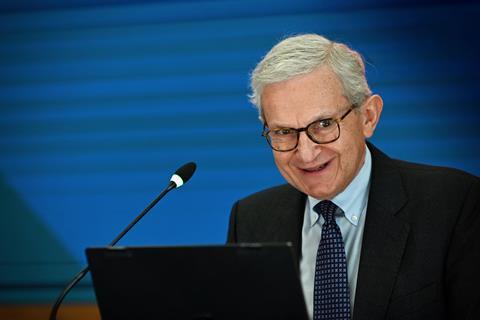
In January 2021, in a lonely socially-distanced ceremony, former Chancery silk Sir Geoffrey Vos was quietly sworn in as the 98th master of the rolls. His six years in the role have been punctuated by bullish addresses on the opportunities – and threats – posed by new technologies.
‘Technology provides part, if not the entirety of the solution to many of the problems we face in our justice system,’ he told MPs in 2023.
The profession knew what it was getting. In 2018, as chancellor of the High Court, Vos made a startling prediction about the implications of round-the-clock ‘on chain’ data created by ubiquitous mobile phones and other devices. ‘Factual disputes as we know them will become almost entirely a thing of the past certainly in most civil claims,’ he said in his inaugural Law Society Future of the Law lecture.
An early calling card was his professed papyrophobia. In 2021 Vos declared he had been a paper-free judge for two years – once memorably refusing to touch the paper brochure of a conference at which he was keynote speaker.
On his appointment, Vos vowed to ‘radically rethink’ civil justice, telling a bar conference that new kinds of dispute resolution would be needed for the world of blockchain, cyber assets and artificial intelligence. He later outlined a vision of public and private websites providing the front end of an integrated online civil justice system, with almost all matters being resolved online. However his initial metaphor of the system as a ‘funnel’ was soon abandoned.
In November 2022 the advent of large language model AI transformed the technology debate. Vos was quick to point out that the legal profession – including the judiciary – would not be able to sit this revolution out. Addressing the Legal Geek networking event, he noted that AI was simply a tool. ‘Like a helicopter or a chainsaw, in the right hands it can be jolly useful, in the wrong hands jolly dangerous.’
'Technology provides part, if not the entirety of the solution to many of the problems we face in our justice system'
Sir Geoffrey Vos
On other occasions he cautioned colleagues not to let ‘silly examples’ of bad practice put them off the new technology. ‘Any professional is personally responsible for their own work produced, however it is produced. If an expert, lawyer, accountant, engineer, or doctor produces inaccurate or unreliable opinions…[they] are likely to be liable whether they used AI or not.’ Meanwhile, far from bemoaning AI use by litigants in person, Vos said that AI-generated submissions are ‘often, if not always, more concise [and] make more sense’. Earlier this year he urged legal educators to be aware of the challenge of the ‘TikTok generation’ of AI-equipped clients.
He has several times called for a debate about the role of AI in judicial decision-making. Individuals and business are ‘very likely’ to want their minor disputes to be decided by machines ‘when they understand such resolutions will be far quicker and far cheaper’ than human judges.
In some areas, AI’s advantages will be such that lawyers may be unable to show reasonable skill and diligence if they fail to use the new tools, he said. The judiciary will not be exempt: ‘It may not be long before parties will be asking why routine decisions cannot be made more quickly, and subject to a right of appeal to a human judge, by a machine.’
Giving the Blackstone Lecture at Pembroke College, Oxford in 2024, he suggested that fundamental rights will need to be created to protect humanity from the ‘genuinely new risks’ posed by artificial intelligence and climate change. This might include a fundamental right to have human rather than machine oversight of ‘decisions requiring empathy or emotional intelligence’.
Vos has had the satisfaction of driving some ideas into reality. One is the Online Procedure Rule Committee, with its new ‘basic general rules’ for court-based online legal proceedings. Another is the output of the UK Jurisdiction Taskforce, part of the LawtechUK initiative, which has published statements on the legal status of digital assets and liability for AI harms.
Last month Vos made his third address as master of the rolls to the Legal Geek event – at which he is invariably the only attendee in a suit and tie. Looking back at his previous speeches he was delighted to point out that his 2024 predictions on the use of AI had ‘become a complete reality’.
Alas the dream of a technology-based solution to the justice system’s problems has not. Yet.













No comments yet